On March 17, I was the featured speaker at the annual Young Authors contest award ceremony, held by the Eastern Shore Literacy Association. The awards recognize the best poets and short-story writers in grades 1-12. I helped hand out the awards, and then afterwards, I signed books for any who wanted them.
You can watch my speech here or on YouTube, or read the transcript underneath the video. Thank you to Jessica Webster of The Salisbury School for inviting me, and to Brian Cook, head of the ESLA, for having me.
Good evening. Happy St. Patrick’s Day. Thank you for having me here. I’m delighted to have the chance to speak to you, and if you’re worried that this is going to be a long, boring speech, don’t, because it won’t be. As a parent, I sat through a lot of school programs, too, and afterward, I never thought to myself, “Gee, I wish that fellow that I had never heard of before would have kept on talking longer so that I could stay out late on a weeknight.”
I was asked to talk about my experiences as a writer, and I will—briefly—but then I’d like to speak about the most important people in the room, and they would be you, the students getting these awards. So, let’s dive in.
I started my writing career right where you are. Well, not here, at Stephen Decatur High School in Berlin, MD, but at Solano Elementary School in Phoenix, AZ. My 4th grade teacher, Mr. Ricketts, gave us a writing assignment every Friday, usually a page or so, to be done in class.
The topic alternated each week between writing a journal about our daily lives, or creative writing. I was never very excited about the journaling, but I really got into writing short stories, usually very fanciful ones, with all kinds of weird things happening that only a 4th grader’s imagination can come up with.
4th grade came to an end, but I kept writing short stories. A few years later, in the summer of 1977, I saw a movie that changed my life: the very first Star Wars film. I decided then and there that was what I wanted to write. So, I did.
6th grade started, and my home room teacher, Mr. McQuade, noticed that I was spending all my free time writing in pencil on regular lined school paper, and when he found out that it was my own version of Star Wars, he excused me from English classes for the rest of the school year. He said, “You just write,” so I did.
And that’s how I wrote my first novel, when I was 11 years old, and Mr. McQuade made a copy and put it in the library there at Grandview Middle School in Phoenix. I still have the original, almost 50 years later.
I went to high school, I took journalism and joined the school newspaper. I wrote poetry and short stories and essays that appeared in the annual literary magazine. The summer after my sophomore year, I wrote a horror novel.
In my junior year, I started writing a post-apocalypse novel and finished it in my senior year, then rewrote it in my first year of college at the University of Maryland in College Park. In my last year at UMD, I started writing a novel that I eventually published 30 years later.
After college and graduate school, life got really busy—I was married and we had babies, and I worked two and three jobs at a time, eventually becoming a technical writer for the US Census Bureau. I was so busy that I got away from creative writing for a while.
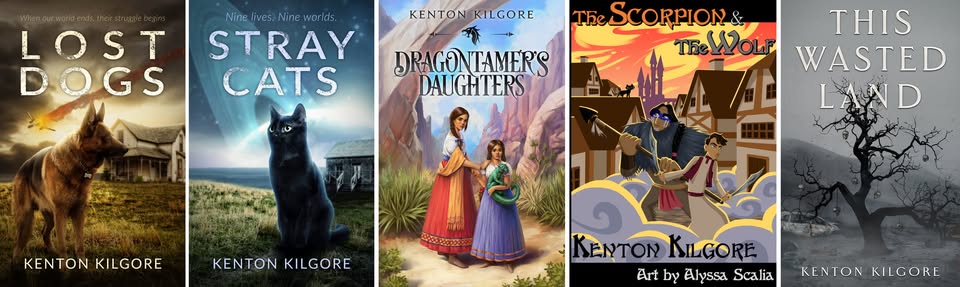
I got back into it with a bedtime story that I wrote for my girls. They got bigger, and the story got bigger, and I published it as a young adult novel in 2012. It’s Dragontamer’s Daughters, about dragons in the Old West: I sometimes say, it’s like Little House on the Prairie with dragons, because dragons make everything better—obviously.
I kept writing. In 2014, I published another novel, Lost Dogs, about a German Shepherd named Buddy who goes through the end of the world. The book is told from his point of view, so you get inside his head—what he sees, hears, smells, thinks—as he tries to survive and reunite with his human family. And no, he does not die. That’s the question I get asked most.
People liked Lost Dogs so much that I did a book about cats—Stray Cats—a few years later, but it’s a quite different. The idea in Stray Cats is that cats do have 9 lives, but instead of living them one after the other, they live them all at once, on different worlds.
One world is the world of Lost Dogs, where everything has come crashing down. One world is our real world, where she can talk to her owner the way I’m talking to you. In one world, she’s fighting aliens alongside a Space Marine, in another, she’s a superhero in a comic book, and so on. It’s much more fun and upbeat than Lost Dogs.
I did another novel—finishing that one I had started in college—in 2018. It’s called This Wasted Land, and it was very much influenced by Stephen King, so you know it’s all kinds of scary and dark and wrong.
Last year, I published a swords-and-sorcery novel for boys called The Scorpion & The Wolf because I learned that a lot of boys these days don’t read much, and I think it’s because they don’t have stories written specifically for them. And I’ve done a bunch of kids’ picture books, just for a change of pace.
So that led me here, and now I’m going to stop blabbering about me, and talk about you. I’ve never met any of you, but because you’re writers, I know three things about each of you. The first is that you’re smart, and I know that because dumb people don’t write stories or poems or books. Instead, they watch TV, or scroll on TikTok.
The second thing I know about you is that you’re talented. You may not be as talented as “Insert name of your favorite author here,”—at least not yet, but if you keep going, and keep honing your talent, you might be. I know you’re talented because most people usually don’t do stuff that they aren’t good at, at least for long. Unless it’s golf.
The third thing I know about you is that you’re dedicated. Because writing is hard work, and stuff you would think would be easy, often isn’t. The first time I tried putting together a kid’s book for publication, I thought it would take a weekend. It took months. Writing kids’ books is harder than you think. Writing poetry is much harder than you would think. And only people who are dedicated sit down and do the hard work to make it happen.
I hope this is just the beginning for you. I hope that you continue writing all through school, into college, and afterwards. And I hope you develop your own style, your own voice, and bring out your stories and words, because the world doesn’t need another Stephen King, it doesn’t need another JK Rowling, it doesn’t need another Sarah J Maas, it needs YOU.
I’ve been writing stories for over 50 years, it’s what I do, it’s who I am, so, let me offer you three pieces of advice to help you in your writing journey, no matter what route it takes or how it looks. And after that, I’ll warn you about a Big Lie, and then I’ll be quiet and we’ll get to your awards, the reason why we’re all here.
My first piece of advice is to write what makes you happy. This goes totally against what all the writing “experts” out there say, who insist that you have to “write to market” and write “what’s hot” and chase trends.
Right now, the big money maker is romantasy, but before that, it was young adult dystopian books, and before that, it was military fiction, and before that, it was Twilight rip-offs, and before that, it was Harry Potter clones. You don’t need to write what everyone else is. Just write what you like to write, and if you do it well, plenty of other people will like it, too. Trust me on this.
Don’t get me wrong, I enjoy making money: I just sold a lot of books at Awesome Con in DC this past weekend. But if the driving reason why you’re writing is so that you can become rich and famous, there are other, quicker, easier, more reliable ways to accomplish those goals than writing. If you want to be rich, go to work developing AI, or go into investment brokering, or something like that. If you want to be famous, go make silly videos on TikTok.
But if you’re going to write, write what you like and do it the best you can. And the great thing about being a writer is that the longer you do it, the better you get at it. It’s not like being an athlete, where you peak in your 20s, and if you keep playing much longer than that, the worse you do, and the more embarrassing it is. I’m a much better writer now than I was when I published my first book, and I was a much better writer then than I was when I was back in high school.
So, write, and keep writing. My second piece of advice is to keep learning and growing as a writer. Don’t just do the same thing over and over. Too many writers just write one kind of thing, and they get stuck, and don’t get any better. So, don’t be afraid to write in a genre or style that you’ve never done before. If what you try doesn’t pan out, if you don’t like it, you can always write something else, but try new things, learn some new things.
Speaking of learning, my third piece of advice is to find and learn everything you can from great teachers. All through elementary school, and middle school, high school, undergrad at College Park, and graduate school at Washington College here on the Eastern Shore, I had amazing teachers who helped and guided and encouraged me along the way. And not all of them were English teachers: one of my favorites was my high school Latin teacher, Mrs. Squier. Pro tip: if you want to become a better writer, take at least a few semesters of Latin. Trust me on this.
Those are my three pieces of advice for you. In closing, I want to tell you about the Big Lie. You may have already heard this Big Lie, whispering inside your head while you’re trying to write. This Big Lie has several variations. Here are just some of them:
“You aren’t any good.”
“Your writing stinks.”
“You’re wasting your time.”
“This is a pipe dream.”
“You’re a loser.”
“You have no talent.”
“Nothing will ever come of this.”
“If anyone reads this, you’ll look like an idiot.”
“You’re embarrassing yourself.”
“No one will ever want to read this.”
“You should quit.”
As I said, the Big Lie has several variations, but its singular goal is to discourage you. To make you give up. To silence your voice, to waste your talent. Do not listen to this lie. Do not believe this lie. It is not true. Not one bit of it is true.
Nor is this lie unique to you. Every writer has heard this lie. Every one of them. The reason why you know about the writers you do is because they did not listen to this lie. They did not believe it. And neither should you.
Now, I’m not going to spin you a fairy tale and try to convince you that all of you will achieve whatever your dream of being a writer is. I’m not going to tell you that you will be the next “[insert name of your favorite author here]”.
I’m not going to tell you that you’re going to sell millions of copies of all of your books and become rich and famous. Because to get there, a lot of things have to happen, almost all of which are outside your control. Being talented and working hard isn’t enough in the book business: there’s an awful lot of luck and other people involved. Is that fair? No, but that’s just how it is.
What I am going to tell you, though, is that if you keep writing, if you publish your work, either through a traditional publisher or by yourself, and if you put it out there, you will write a story or a poem or an essay or a memoir or a history that touches someone and makes a difference in their life, a piece of your writing that they will carry around in their head for the end of their days and cherish it like it’s a treasure.
And if those readers meet you, or can find you online, they will tell you that. It’s already happened for me, many times, and I know it will happen for you. Trust me on this, and go make it happen.
Thank you again for having me, good luck in the future, reach out to me if you want more advice or help, and congratulations on your awards.
Kenton Kilgore writes books for kids, young adults, and adults who are still young. Follow Kenton on Facebook for frequent posts on sci-fi, fantasy, and other speculative fiction. You can also catch him on Instagram.