
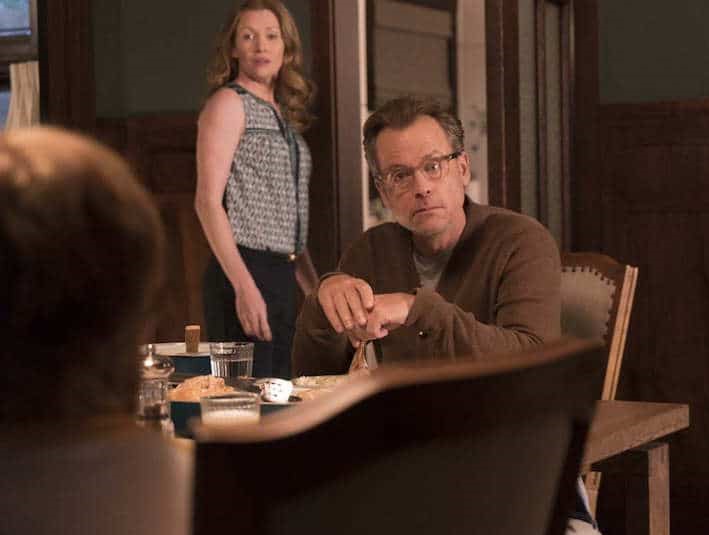
…is what I’m going to share with you from Philip K. Dick’s disturbing short story, “The Father-Thing,” first published in 1954, and adapted into an episode of a TV show in 2017.
If the name Philip K. Dick sounds familiar, it’s because he was a prolific sci-fi writer whose works inspired many films, most notably the cyberpunk classic Blade Runner.
He is considered one of the greatest and most influential speculative fiction writers of the 20th Century, winning a Hugo Award (back when they meant something) for Best Novel, and being nominated for several Nebula Awards. Dick died of a stroke in 1982, four months before Blade Runner was released.

I first encountered his writing in middle school in the 1970’s. Included in our reading class anthology was “The Father-Thing,” which comes across like a collaboration between sci-fi legend Ray Bradbury and horror-movie director John Carpenter.
(If you’re squeamish, you may want to stop reading now and…I don’t know. Maybe go watch lip-sync videos on TikTok)
“The Father-Thing” is about an eight-year old boy named Charles, who is convinced that his father has been replaced by someone–or something–else.
While Charles is poking around the garage at his family’s home, he makes a gruesome discovery inside a trash barrel:
The father-thing had stuffed it down in the very bottom of the barrel. Among the old leaves and torn-up cardboard, the rotting remains of magazines and curtains, rubbish from the attic his mother had lugged down here with the idea of burning someday. It still looked a little like his father enough for him to recognize. He had found it — and the sight made him sick at his stomach. He hung onto the barrel and shut his eyes until finally he was able to look again. In the barrel were the remains of his father, his real father. Bits the father-thing had no use for. Bits it had discarded.
He got the rake and pushed it down to stir the remains. They were dry. They cracked and broke at the touch of the rake. They were like a discarded snake skin, rustling at the touch. An empty skin. The insides were gone. The important part. This was all that remained, the brittle skin, wadded down at the bottom of the trash barrel in a little heap. This was all the father-thing had left; it had eaten the rest. Taken the insides — and his father’s place.

Remember, this was reprinted in a school book for children. Man, the Seventies just DGAF when it came to kids.
And that’s not even the big reveal at the end, that’s only two or three pages in. For 45 years after I read “The Father-Thing,” I never forgot that scene, even when I couldn’t remember the name of the story (I rediscovered it recently) or who wrote it.
(If you’ve made it this far, then you might as well keep going, but now things are really go off the chain. Just so you know. Oh, and spoilers, too)
I shamelessly admit that Charles finding his dad’s skin was the inspiration for a similarly disturbing scene in my dark fantasy novel This Wasted Land, when our feisty teenage heroine Alyx is “reunited” with her boyfriend’s big sister:
Cynthia’s hanging there.
I jump back, point the gun oh my God oh my God oh my God it can’t be her, it can’t be Sam’s sister, but it is–her skin, anyway. Just her skin.
It’s like a big, empty, plastic bag. Blood’s seeping out of her, running down her legs, trickling onto the floor into a puddle. She’s naked and her hair is all tangled and she–it–is just floating there, her toes–some of her pink nail polish is chipped–dangling a few inches over the beige tiles. Her face is flat, saggy, empty, cocked to one side like it’s staring at something. Or it would, if it had eyes.

So, if you have nightmares after reading that scene with Alyx and what’s left of Cynthia, don’t blame me, blame Philip K. Dick. You can find This Wasted Land on Amazon for KU, on Kindle, and in softcover. And if you dare, you can read the rest of “The Father-Thing” by downloading it at the link below.
Kenton Kilgore writes killer SF/F for young adults and adults who are still young. Follow Kenton on Facebook for frequent posts on sci-fi, fantasy, and other speculative fiction. You can also catch him on Instagram.